
Frame Rate
Your Reviews Are Now Read by Machines
A review used to persuade one reader at a time. Now an AI assistant reads every review a business has and repeats what they say. The reviews that name what a business does well are the ones it repeats.
 Howard Allson
24 Frames Media, Bath · 17 November 2026 · 5-minute read
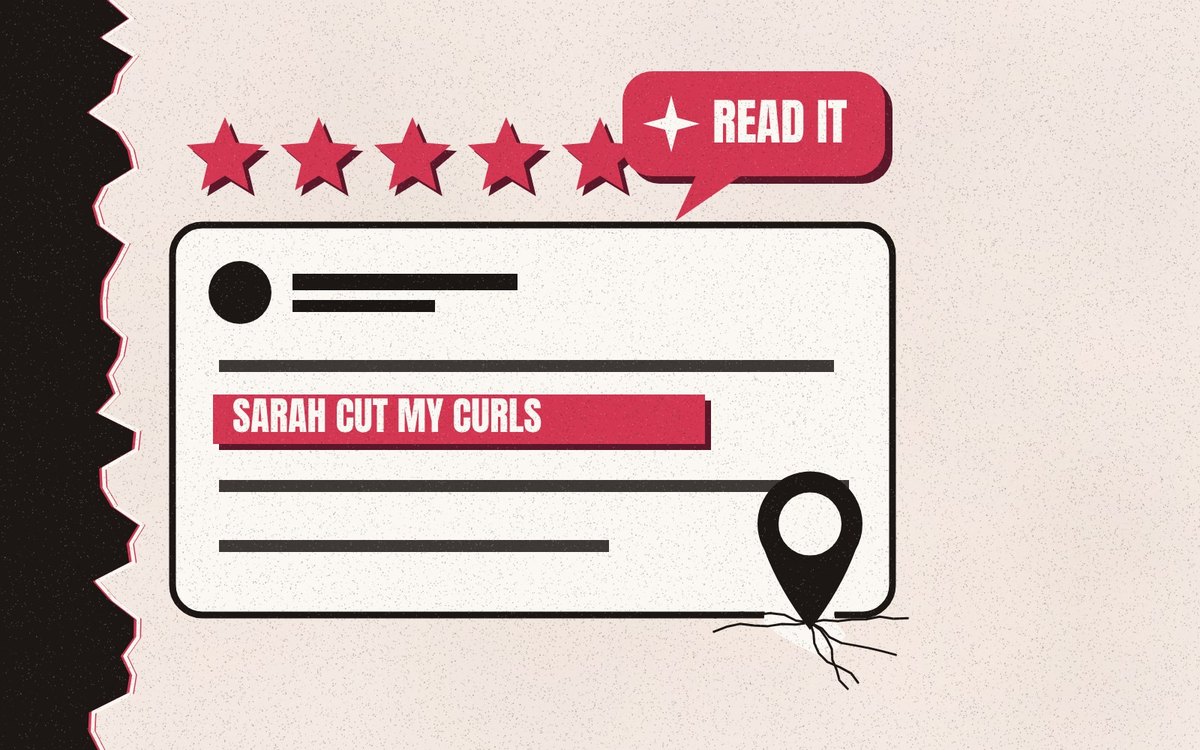
Ask Google which hairdresser in Bath is good with curly hair, and the answer reads like advice from a friend who has asked around. When we tried it in AI Mode this week, it named eight salons. For six of them it named a stylist, by first name, whom reviewers had praised for working with curls.
That is a small moment with a large consequence. A review is no longer read only by the next customer who scrolls down a profile. It is read, along with every other review, by software that summarises them for people who may never scroll at all.
More customers ask an assistant first
The habit is spreading quickly. BrightLocal's 2026 survey of 1,002 consumers in the United States found that the share using ChatGPT and other AI tools for local business recommendations rose from 6% in 2025 to 45% in 2026, making AI the third most-used source. The same survey found that 82% of consumers read AI-generated summaries of reviews.
Those are American figures. But Google's AI Mode, which answered our questions from Bath this week, draws on reviews in the same way.
Volume opens the door
In May 2026 Insites, a company that sells visibility tools, published a study of 10,000 local businesses in the United States, comparing more than 200 signals with what ChatGPT and Perplexity said about each business. Businesses found by both assistants averaged 133 Google reviews. Businesses neither assistant found averaged 11.
That shows a link, not proof of cause. It fits what we saw in Bath, though: an assistant can only repeat what customers have written.
The same study found a second gap. 93% of the businesses were known to at least one assistant, but only 55% were described accurately; the rest had wrong addresses, wrong hours or mismatched services. Being known is common. Being described correctly is the opportunity.
Detail decides what gets repeated
Volume decides whether a business is in the conversation. Detail decides what the assistant says about it. Compare two five-star reviews, written here as examples:
- "Great service, would recommend."
- "Sarah cut my thick curls and showed me how to style them at home."
Both are welcome. Only the second tells an assistant what the business is good at, for whom, and who does it. Asked about curly hair, the assistant has a sentence to repeat.
The same holds for every trade. A plumber whose reviews mention coming out on a Sunday is easier to recommend for a Sunday leak. A florist whose reviews mention wedding flowers is easier to recommend for a wedding.
Recent reviews count with people too
People still read reviews themselves, and they look at the dates. BrightLocal found that 74% of consumers only care about reviews written in the last three months. A steady trickle of reviews this season says more than a burst of reviews two years ago.
Replies are part of the record
Replies are read as well. In the same survey, 89% of consumers expected owners to respond to reviews, and 50% said a templated or generic reply would make them unlikely to choose the business. Google has tested an option in Business Profile this year that drafts review replies with AI. As a first draft it can save time. The reply worth posting is the one that mentions the customer's actual visit.
Your website can carry the best lines
Reviews live on Google, but assistants also read the business's own website. In the Insites study, the business's website was the source ChatGPT cited most often: in 72% of the questions about what a business is and how it is regarded. A page for each service that carries two or three of the most specific review lines, with the customer's permission, puts those lines where an assistant looks first.
A hard review, answered well, still helps
Not every review will be glowing, and an assistant reads those too. BrightLocal found that 42% of consumers are unlikely to use a business that never replies to reviews. A short, calm reply that thanks the customer, says what has changed and offers a way to talk shows the next reader, and the next assistant, how the business behaves when something goes wrong.
Asking the fair way
One rule is firm. Since 6 April 2025, UK law has banned fake reviews and reviews that hide an incentive. Every review should come from a real customer, in their own words. What a business can do is ask, at the right moment, in a way that helps the customer write something useful.
A review request that gives an assistant something to read
Send it within a day of the visit, while the details are fresh:
"Thank you for coming in today. If you have a minute, a Google review helps other people find us. It's most useful if you mention what you had done and who looked after you."
Five habits that keep useful reviews coming
- Ask every customer, not only the ones you expect to be delighted.
- Make it one tap: send the review link from your Business Profile.
- Ask within a day, while the visit is still clear in the customer's mind.
- Reply to every review, mentioning something specific from it.
- Read your reviews each month and note the words customers use. They are the words to use on your website too.